And …. more engine work!

Pfew, on Double Espresso, with the old outboard, there was no maintenance that I did. But Changabang’s diesel engine is more demanding. It’s also essential as without it I can’t imagine myself getting out of and into my slip (as I could with Double Espresso). So today I took a day off work to make more progress and:

  • Clean the seawater strainer.
  • Replace the seawater pump impeller. When inspected the old one had a couple of small cracks.
Seawater pump, impeller cavity

After I placed orders for oil and coolant: next are the oil change on the sail drive and the coolant flush.

I also replaced one of the two fire extinguishers. The show must go on … The thing that most preoccupies me with the PacCup race is getting to the start line and not being 100% ready. I don’t mean from a sailing skills perspective )as that can always be improved) but from a boat systems perspective.

I explored a couple of other items too:

  1. The purchase system to pull down the hydrogenerators: I flipped it and now I can reuse an existing cam cleat instead of installing another one. I also extended one of the lines, which was too short and always a mess to hook to the purchase/tackle. I put anti-chafe tape where the line may be chafing.
  2. I explored a new solution to lead the backstay control line to the cabin top winch. It’s pretty straightforward with a line from a toe rail pad eye with a low friction ring deflecting the backstay control line to the winch. I don’t think that winch can take a lot of load but it’s certainly a start.

Moving on …

More engine work

After the lubrication system, I focused on the fueling system. I replaced the fuel filter and the fuel pre-filter insert today. Next, I’ll have to care for the cooling system, the seawater pump, and the seawater filter.

Yesterday I spent some time in the navigation table removing a few old items and cables. It looks a little tidier in there but it’s still a messy bundle of cables. I also removed the old satellite terminal.

Today with Alex we also started sorting out the liferaft situation. The access door was well shut so we had to cut through the seal and we’ll have to get that repaired. I think we have a good solution now (which was there all along):

  1. Open the aft access door to the liferaft compartment;
  2. Pull the liferaft out and let it drop into the water;
  3. Pull the painter to a cleat if necessary;
  4. When ready to board, proceed.

Last, we cleared out a few last hurdles for the safety list of the PacCup and identified what needs to be done. One thing that’s amazing with these events is the number of small things that need to be thought through. It all adds up. Most importantly these things need to be tested at sea. There are still plenty of big things to go through for sure, for example:

  • Film a crew overboard recovery sessions.
  • Devise an alternative method of steering (drogue?) and test it upwind and downwind.
  • Figure out our sail crossover chart.

A few updates

So we did re-install the Kevlar cables but … the headstay is not tight enough and there is too much tension in the V1 (Alex got a Loos gauge!). So we’ll have to re-do the headstay lashing. Oh, oh, and Alex put the down payment for a new A2 and a new (fancy) jib!

In the small updates category, I replaced the three 12V sockets. This is both preventive maintenance (corrosion possibly damaging these) and an upgrade (replacing two of the cigarette lighter sockets with USB plugs).

New USB chargers

I also ventured into diesel engine maintenance today, which proved to be quite hellish. I purchased the parts to replace the oil filter, fuel filter, pre-filter fuel insert, and impeller. I also purchased an oil extractor. So today I proceeded to extract the oil with what proved to be more a toy than a tool. It took almost two hours. Then I tried to twist off the oil filter but it wouldn’t budge. To make a long story short it took three trips to the Nappa store downtown Half Moon Bay to get the right tool (and with traffic, each trip was about 45-60 minutes long). Ultimately, I got the oil filter off and a new one in. So I think that job is done pending leak monitoring over the next few engine runs. So that’s 1 of 5 jobs and it took me 7 hours. At this rate … What’s left is 2 filters, the impeller, and a coolant topping or flushing.

With the filter off.

And we’re back!

My trip to France was not as successful as I had hoped. The big plan was to get in with the NavTec cables, drop them at the rigger, pick them up on my way back to the airport, and fly back with them. Well, it was a tight plan and it didn’t work. Don’t fret, they were shipped back, and I got them yesterday after a few hooplas with the customs clearance. And here’s the box after a long trip!

Important stuff!

Today, with Alex, we put it all back together. As discussed in the previous post, I replaced the chainplate fitting and this will work much better for at least two reasons: one, there isn’t room for chafe; second, if there is chafe it will be visible! As previously, getting enough tension in the headstay took a couple of tries. And I think we may still want it tighter than it is now.

New headstay fitting!

Unless I’m getting taxed for import, the cost will have been less than $5,000 (not including my trip to France) to replace the headstay, the inner headstay, the 2 upper backstays.

There are still quite a few things to do to get ready for the PacCup event so more to come!

A trip to France

I combined visiting my mother with sailing related activities. Monday we were in Locmariaquer visiting with Xavier of Atelier Cables. They were the original riggers of CaB. We may be able to make things work and I may be able to bring the new cables back with me next week. After a very long day we sleep in Quiberon. The next morning I hiked along the Côte Sauvage (like I did two years ago). After that we had lunch with the team at Atelier Cables and discussed things more, in particular how the headstay lashing is being damaged. Originally the fitting was going to be something else but the builder decided against. We’re going back to the original design. It’s ugly and heavy but it should prevent the lashing from fraying. The fitting to the head chainplate is also original so we decided to replace with a new one.

New headstay setup!

On our way back to my mother’s we stopped in Nantes and I spent a couple of hours with François Lucas. The key takeaway was the chart below. In total there should be about 4 cubic meter of reserve buoyancy. It would be good to add more in the back to even out though.

Kevlar rigging off

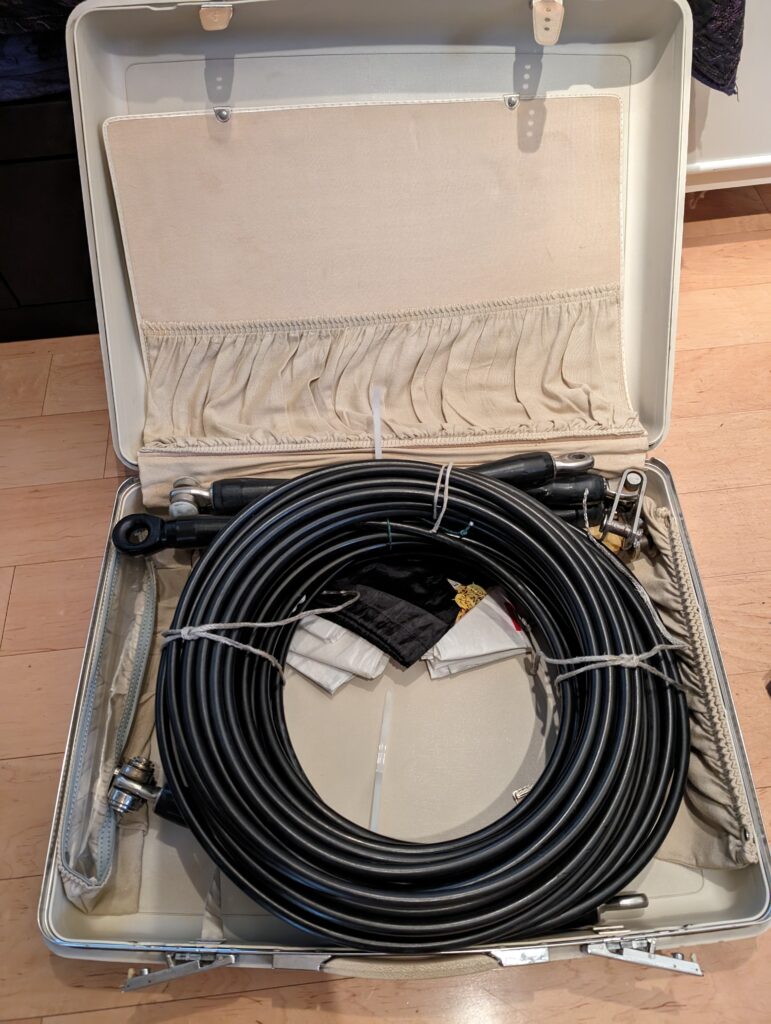
A few months ago we decided to replace the headstay, the inner headstay, and the upper backstays. The plan is to replace them with equivalent NavTex and even re-use the end fittings of these sleeved Kevlar cables. Today we took them down. Alex first sent me up the mast to retrieve the inner headstay and the upper backstays. And then we released the turnbuckles for the D1 and the V1 so that we could remove the headstay lashing. All the while we kept the mast under forward tension using the jib and the spinnaker halyards. We reset the turnbuckles and loaded the inner backstays. I think the mast is well stabilized.

I brought the 4 cables home and fit them in a suitcase to take them back to France, here: https://ateliercables.fr/

Ready for smuggling into France 😉

While we were there I also charged the batteries a bit and started the engine. It will at least be 3 weeks before we sail again.

Furling sails

Yesterday with Alex, we had a good day working with the masthead code 0 and the gennaker. I was reminded that the gennaker is fractional and requires a swivel at the head; I rigged it masthead, without a swivel. And when I tried to furl it back in, I ended up putting twists in the halyard, which finished to destroy the cover in a couple of places.

Just not enough time

A bit of sailing this Saturday. This morning I had to help my child with her homework and it wasn’t until past 10 that I could leave the home. With horrendous traffic, I ended up at the boat past 11:30.

The forecast was for 10+ kts with a fair sea. My plan was to get out of the harbor and pop the A2 for a while. As we sailed out, the wind was getting closer to 20 kts. I kept the solent up and prepared for the A2 hoist. It was a bit wet but hoisting with the solent up worked just fine and we were powering at 10-12 kts. I didn’t drop the solent but as we were getting away from Pillar Point wind started dropping and I could have.

After dropping the A2 behind the solent, packing it back up, and sorting lines, I worked upwind going West, and then tacked to get back home. Once in port then I partially fixed the starboard bow netting. Unfortunately, I also broke something: the wooden board that sits on top of the ballast plumbing. One more thing for the list!

Again, heavy traffic to get back home, and after a quick shower, it was past 6:30.

What did I learn? It’s ok to hoist behind the solent! But drop it when the wind drops below 15kts, in favor of the staysail.

A fresh reminder

Lately, sailing out of Pillar Point has often meant sailing in 8-15 kts of wind in a fair swell. But today brought back the good old 20-25 kts in an 8-10 ft swell. I sailed out under jib and full main, keeping the AWA between 40-50. Some of the rollers were impressive. There were times when it felt like Changabang genuinely climbed up the waves. Of course, the sea state was a little confused and we were drenched several times. I did load the ballast and, a first in a long time, I wore my life jacket and used my tether. Moving about CaB as we were heeling and being rocked about was good sport!

When it came time to tack, I first went off the wind to store the inner headstay out of the way, to make tacking easier. Then I emptied the ballast to leeward, and tacked away, sailing back to port. I noticed that the jib sail bag was being dragged in the water as I didn’t secure it. So I went off the wind again to secure it properly. At this time Changabang was powering at 9-11 kts and the bow was being generously spread. I took a couple of showers, which I felt good about.

Although I’m back in running form and can run 5-6 miles again (slowly mind you), I find that my upper body strength is not what it used to be. I have lost weight (20+ lbs!) and feel that I need to re-strengthen my upper body. Grinding the winches and moving about proved somewhat difficult, which may be mostly because it’s been a while since I’ve sailed in these conditions. I had grand ideas to try the spinnaker or pole out the jib or even the jib top, but none of that took place. At a minimum, I probably should have reefed …

The tiller sometimes loads up and is very hard to turn. I’m not sure what’s causing this. I don’t think it’s weather helm that I’m fighting. It may be just the power of the waves loading the rudder. But what concerns me is that it maybe that the rudder bearings are damaged.

I saw a whale, a few mola molas, and another sailboat going up to San Francisco under mainsail alone, looking very slow.

Verified by MonsterInsights